Monkey See, Monkey Do: The Science of Training Tiny Baristas
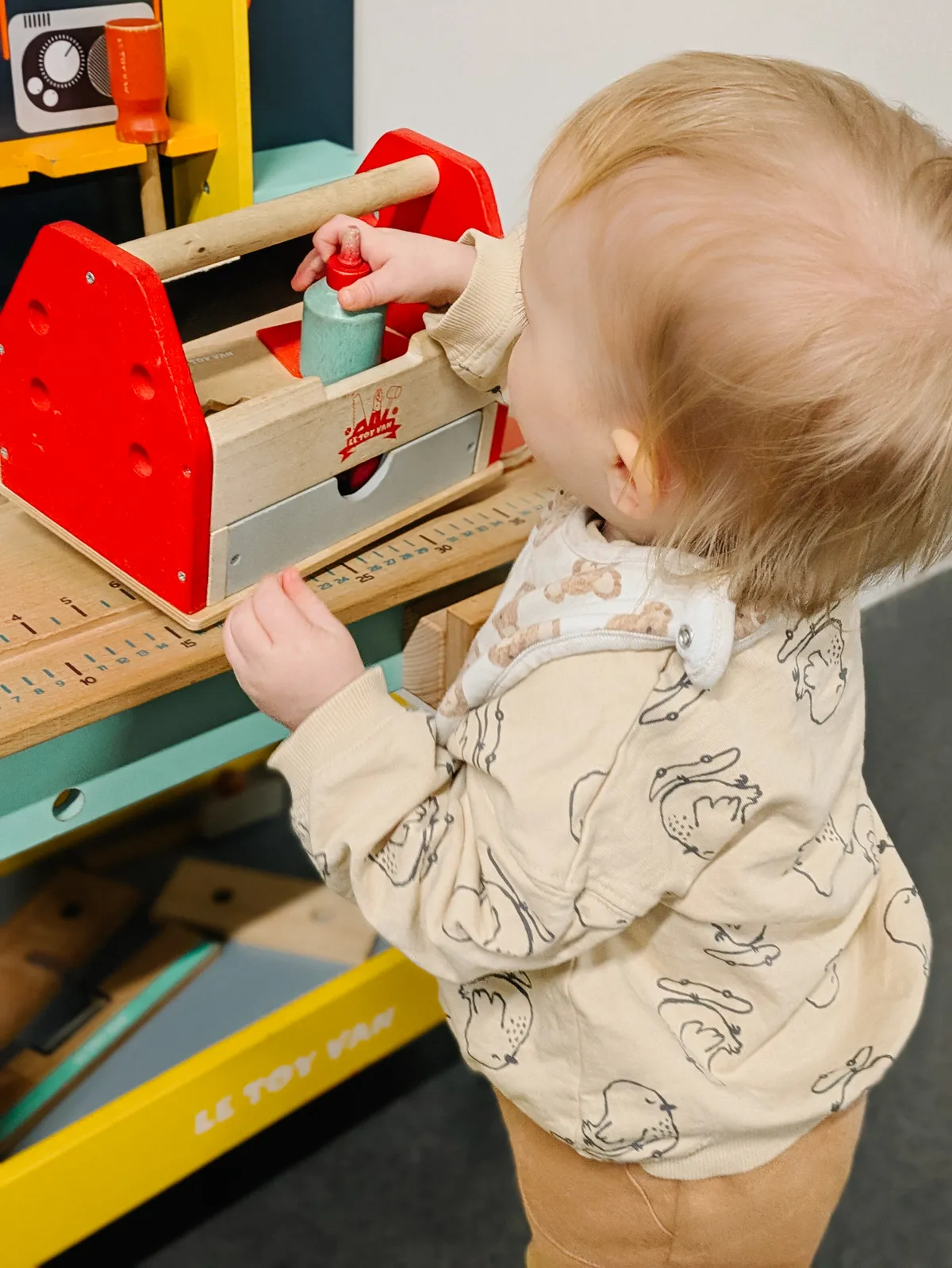
Today, I took Alex to The Little Town of Play in Batley, a roleplay centre filled with miniature versions of real-world settings: a theatre, a vet’s surgery, a garage, a hospital, a farm, a supermarket, a café, even a full-size ice-cream van. It’s a veritable paradise for small children with big imaginations, where they can run wild, test out different roles and importantly, learn through play.
Alex has long been obsessed with his brother’s play kitchen and engine model, so this seemed like the perfect place to let him explore both interests. Sure enough, the second we walked into the café setup, he made a beeline for the toy coffee machine. Now a barista has a specific process: fill the espresso head, tamp it down, attach it to the machine, get a cup, press the button, froth the imaginary milk. Alex is only one. He doesn’t know this yet. But he does know that his dad obsessively brews coffee with a moka pot every morning, and apparently, that was enough.
So, I demonstrated how the coffee machine worked, moving through the above steps one by one... And then Alex, like some tiny, latte-loving hipster immediately copied me near perfectly. My mum and I watched in amazement as he mimicked my movements with careful concentration. And, of course, my mum’s reaction was her favourite phrase: Monkey see, monkey do!
That got my brain whirring: Why are kids so ridiculously good at imitating us?
The Neuroscience of Mini Copycats
It turns out, there’s a lot of fascinating science behind the “monkey see, monkey do” effect. Here’s a quick rundown:
1. Mirror Neurons – The Brain’s Copy-Paste Function
Mirror neurons are special brain cells that fire both when we perform an action and when we observe someone else doing the same action. It’s as if our brains are running a real-time simulation of what we’re watching. This is why kids pick up on behaviours so quickly—whether it’s making coffee, using a screwdriver, or (unfortunately) repeating naughty words at inopportune moments.
2. Observational Learning – Kids are Tiny Scientists
Psychologist Albert Bandura’s social learning theory suggests that kids don’t just copy what they see; they actively study the actions, reactions, and consequences around them. They take mental notes, conduct little social experiments (my niece recently even told her mum she was being "tested"!), and refine their understanding of the world. This is why roleplay centres are a great day out, they go beyond just play and provide endless scenarios for kids to test and learn from.
3. Neuroplasticity – The Brain is a Fast Learner
Children’s brains are incredibly plastic (not in the LEGO sense, but in the rewiring sense). Every time they imitate an action, neural pathways strengthen, making the action easier next time. It’s the same reason why kids can learn languages effortlessly, while adults have to endure Duolingo’s passive-aggressive notifications.
4. Emotional Contagion – Why Yawning is Catchy
After a long day of play, Alex started yawning. And then I started yawning. And then my mum started yawning. That’s those pesky mirror neurons again! Yawning, smiling, even stress. These emotions spread through imitation, reinforcing our social bonds. It’s why you can’t watch someone else yawn without feeling the urge yourself (and I bet you just yawned reading this).
What This Means for Parenting
When kids are this absorbent, it makes you hyper-aware of the behaviours you model. If Alex can copy a barista routine after one demo, what else is he picking up on? (Hopefully patience, kindness, a constant fascination with the world... but also possibly my questionable fashion sense...) It’s a reminder that our everyday actions shape how our children understand the world, whether it’s how we treat people, how we handle frustration, or how we make our morning coffee.
So, next time Alex watches me, I’ll be thinking: What lesson is he learning right now?